
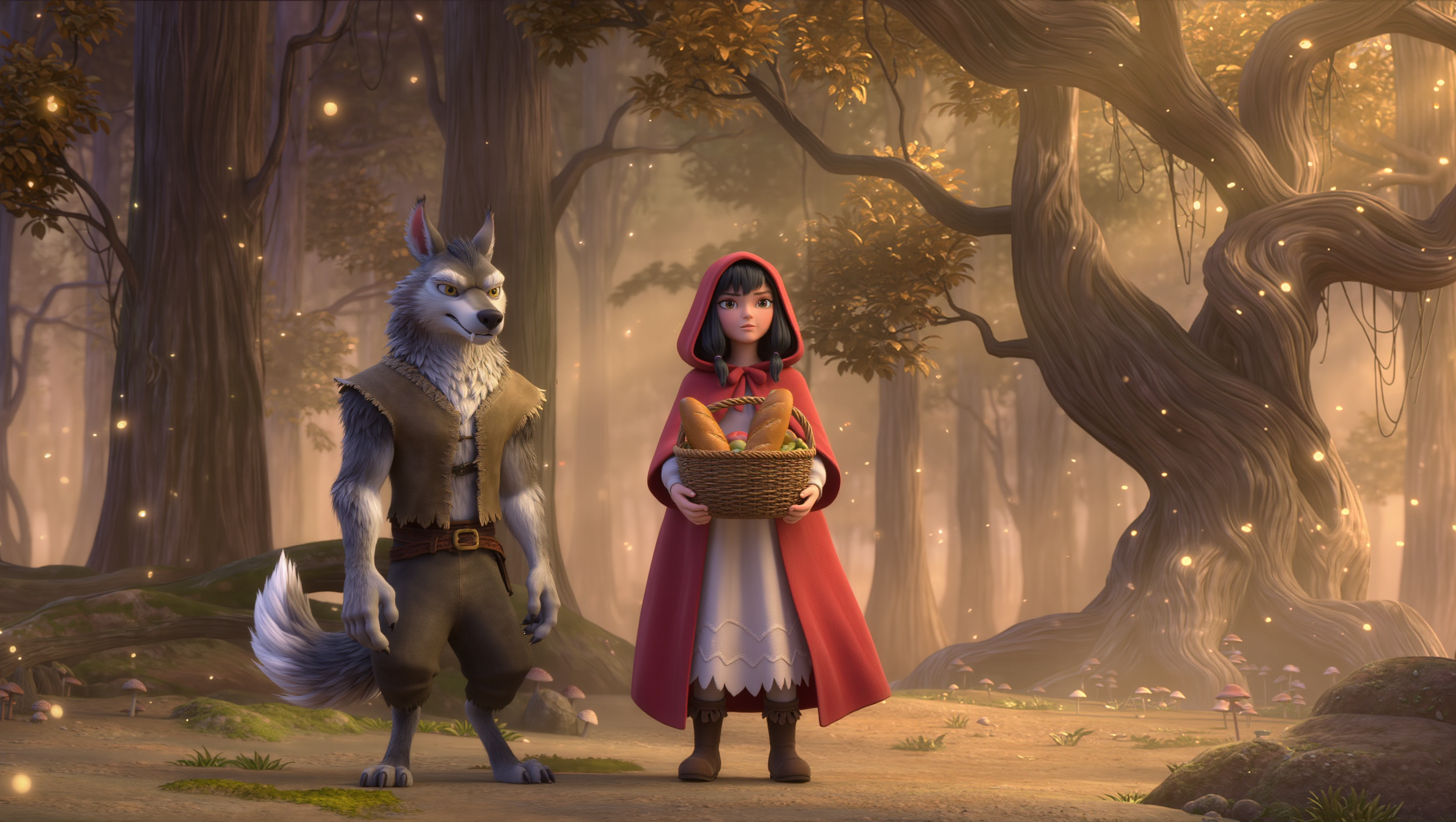
Once upon a time, in a cheerful little village surrounded by woods, there lived a girl who loved to wear a red cloak. Her grandmother had made it for her on her last birthday, sewing it from soft wool and tying it with a ribbon that shone like sunlight through leaves. The girl wore it so often that everyone began to call her Little Red Riding Hood.
She lived with her mother in a small cottage with blue shutters and a garden full of herbs. On most days, she helped her mother gather vegetables or bake bread, singing to the sparrows that hopped along the fence. Red had a bright laugh, a curious mind, and a heart that always wanted to help.
One morning, while the smell of baking drifted through the window, Mother said, “Your grandmother isn’t feeling very well today. Will you take her some bread and honey to make her stronger?”
“Oh yes!” said Little Red Riding Hood. “I love visiting Grandma. I’ll bring her a story too — she always likes those.”
Mother smiled and packed a basket: a loaf of warm bread, a jar of golden honey, a small pot of butter, and a bunch of thyme tied with string. Then she knelt down and brushed her daughter’s cloak smooth.
“Listen carefully, my dear,” she said. “Follow the path through the forest, and don’t wander off. The woods can be confusing, and there are creatures who may not mean well.”
“I promise,” said Little Red Riding Hood, tying her ribbon. “I’ll walk straight there and straight back.”
She waved goodbye, picked up the basket, and set off along the forest path, her red hood bright as a berry among the trees.
The forest was green and cool, filled with the sounds of rustling leaves and birdsong. Sunlight poured through in golden stripes, and the path wound ahead like a brown ribbon. Little Red Riding Hood hummed as she walked, stopping now and then to listen to the wind whisper through the branches.
She loved the smell of pine needles, the way her shoes sank softly into moss, and how the trees seemed to whisper to each other above her head. Every now and then she waved to a robin or bent to pick a shiny acorn. It was a good kind of quiet — the kind that makes you feel part of something larger.
Halfway through the forest, a Wolf appeared from behind a tree. He was tall, with silver fur and eyes that looked like melted amber. He gave a polite little bow. “Good morning, Little Red Riding Hood,” he said smoothly. “Where are you going on such a fine day?”
She had been taught to be polite, so she smiled, though she kept a bit of distance. “I’m going to see my grandmother,” she said. “She isn’t well, so I’m bringing her food and honey.”
“How kind of you!” said the Wolf. “And where does your grandmother live?”
“At the far end of the path,” said Red. “In a cottage with blue shutters and a pear tree.”
The Wolf nodded thoughtfully. “Ah yes, I know that house. But it’s such a long way for small feet. Why not pick some flowers for her on the way? Grandmothers love surprises.”
Red looked around. The path was dotted with daisies and buttercups glowing in the sunlight. “That’s a good idea,” she said. “I’ll pick just a few.”
While she bent to gather flowers, the Wolf’s sharp eyes glimmered with an idea. He smiled to himself, slipped quietly into the trees, and hurried toward the cottage.
Grandmother was sitting in bed, knitting a scarf, when the door creaked open.
“Oh, Little Red Riding Hood, you’re early!” she called. But when she looked up, she saw the Wolf instead. Her knitting needles froze mid-air.
The Wolf blinked. He had meant to be frightening, but Grandmother’s calm gaze made him fidget instead. “I—well—I just came to check on you,” he said awkwardly. “The forest is full of talk about your cough.”
Grandmother tilted her head. “How thoughtful,” she said slowly. “But have you eaten? You look rather thin.”
The Wolf’s ears twitched. “No… not really.”
“Well, you can help me instead of standing there like a lamppost,” said Grandmother briskly. “There’s dough on the counter. Knead it for me.”
The Wolf hesitated, but something in her voice made it easier to obey than to argue. So he put his big paws on the dough and pressed and folded, pressed and folded. Soon the dough began to rise, soft and warm beneath his paws. Grandmother smiled to herself. “There now,” she said. “You’re better company when you’re busy.”
By the time Little Red Riding Hood arrived, the cottage smelled of baking bread and Grandmother was humming again.
Red knocked on the door and called, “Grandmother, it’s me!”
“Come in, dear!” called Grandmother, sounding cheerful again.
Red stepped inside — and stopped. There was the Wolf, standing beside the table, wearing a small apron and a guilty smile.
“Why, Grandmother,” said Red, eyes wide, “what big ears you have!”
“All the better to hear the oven timer with,” said Grandmother, chuckling.
“And what big eyes you have!”
“All the better to see how well the bread is baking,” said the Wolf, embarrassed but trying to sound polite.
Red giggled. “And what big paws you have!”
“All the better to help with the washing up,” said Grandmother, handing him a towel.
Everyone laughed. The Wolf’s ears turned pink under the fur, but he felt something new: pride. He had helped, and no one had run from him.
They sat down together and shared warm bread with honey. Red told them about the birds that had followed her along the path. The Wolf told them about the forest — where the deer drank, where the mushrooms hid, and which trees made the best shade on hot days. Grandmother listened with a smile, because she knew that stories can change hearts faster than scolding ever could.
When they were done, Little Red Riding Hood stood and tied her hood again. “I should go before it gets dark,” she said. “Mother will worry.”
The Wolf bowed. “May I walk with you for part of the way? I know which paths stay safe after sunset.”
Grandmother nodded. “That’s kind of you, Mr. Wolf. And remember — no shortcuts through the briars.”
They all laughed, and the girl and the Wolf set out together. The air smelled of pine and soft rain, and the forest looked golden in the late light. The Wolf pointed out a robin’s nest, and Red showed him how to spot rabbit holes without stepping on them. By the time they reached the edge of the trees, they were walking in easy silence.
At the last bend, the Wolf stopped. “Thank you,” he said quietly. “For not being afraid of me.”
“And thank you,” said Red, “for keeping your promise.” She opened her basket, took out a small heel of bread, and handed it to him. “For your supper.”
The Wolf took it gently. “I’ll remember this.”
Then he turned and padded back into the forest, not with hunger in his eyes but with something softer — hope.
When Red reached her cottage, the first stars were showing. Her mother was at the door before she could knock. “You’re safe!” said Mother, hugging her tight. “How was your walk?”
“Oh, it was wonderful,” said Red. “Grandmother feels better, and I made a new friend.”
Her mother looked surprised. “A friend?”
“A Wolf,” said Little Red Riding Hood proudly. “But a kind one. He helped us bake bread.”
Her mother raised her eyebrows. “A wolf in the kitchen?”
Red nodded. “He’s learning to be good.”
Mother smiled, shaking her head softly. “Then perhaps the forest is changing.”
And from that day on, it truly did. The Wolf sometimes brought wood to Grandmother’s door or left wild herbs on the step. Red always waved to him from the path, and sometimes he walked beside her in silence, just far enough to keep her safe. The forest, once thought dark and dangerous, began to feel like part of their home again.
When travelers came through the village and said, “Beware the wolves of the forest,” the children laughed and said, “Our wolves help bake bread!”
And whenever Little Red Riding Hood tied her red hood beneath her chin, she remembered her mother’s words:
“Kindness and caution can walk together.”
She never forgot them — not once, not even when she was grown.
And sometimes, when she baked bread herself, she left a small piece on the forest path — just in case an old friend happened to pass by.
And they all lived gently, bravely, and kindly ever after.
Kindness can change others — but wisdom keeps it safe.
Courage doesn’t mean fighting the Wolf, and kindness doesn’t mean being naïve. Red learns that care and caution belong together. By listening, thinking, and showing compassion, she helps someone else become better — and learns that true bravery is using both heart and sense at the same time.
Sign in to save words to your Word Garden - a special place to remember everything you’ve learned!
Why did Little Red Riding Hood choose to trust the Wolf?
How did kindness change the Wolf?
What do you think the forest represents?