
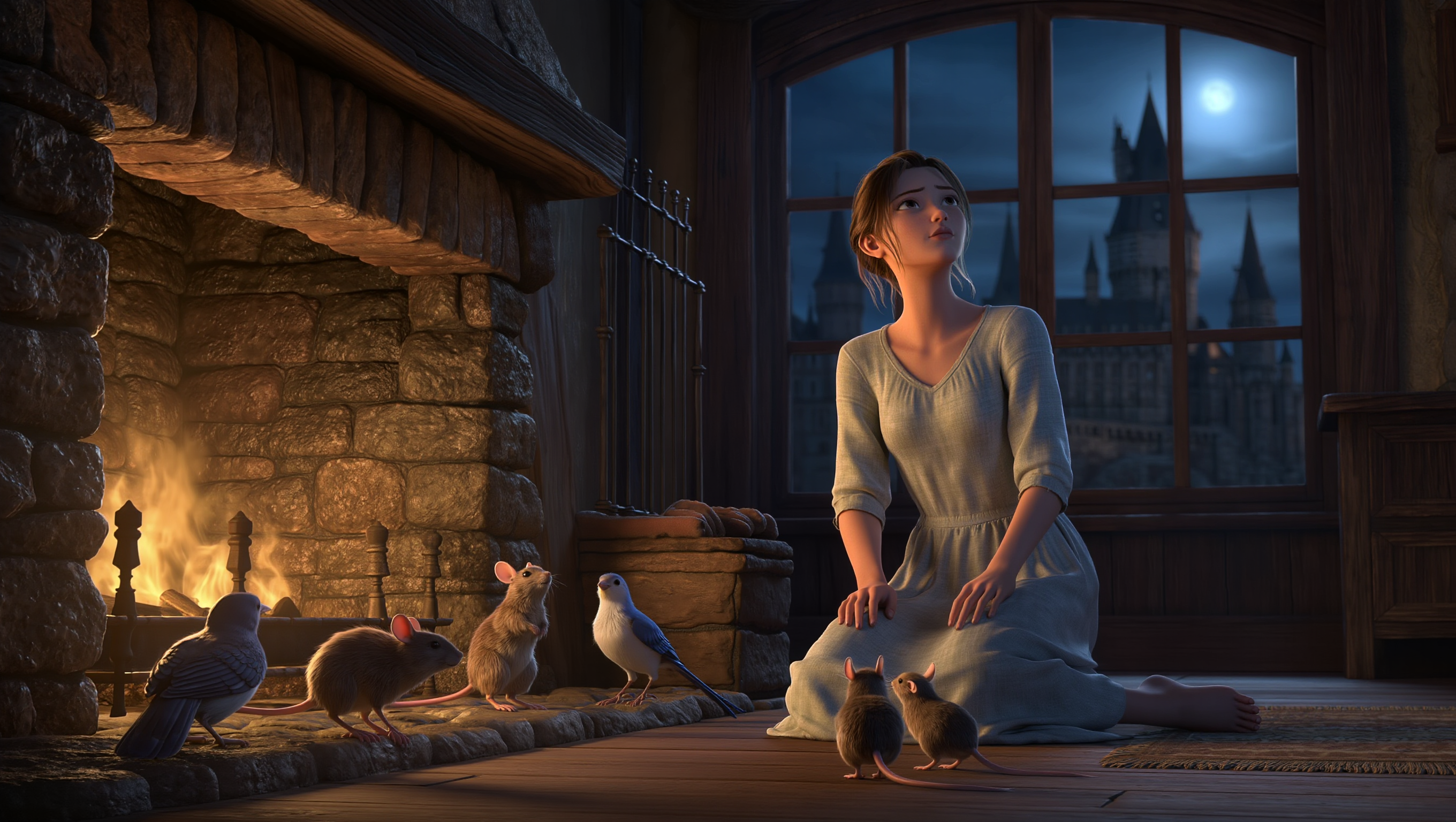
In a small town threaded with cobblestone streets and lanterns that glowed like tiny suns, there lived a girl named Ella. Her mother used to say she was born with “light in her eyes and laughter in her hands,” because whatever she touched seemed to brighten.
When Ella’s mother died, the laughter in the house dimmed, and her father grew quiet. After some time, he remarried—a woman named Lady Tremaine, who came with two daughters of her own. They arrived with trunks full of lace and silk, speaking sweetly to everyone. But sweetness can hide sharp edges.
At first, things were polite. The new family dined together, shared walks, spoke of books and music. Yet when Ella’s father grew ill and passed away the following winter, the stepmother’s smile cooled like water left out in frost.
“This house needs order,” she said. “And someone must keep it.”
That someone became Ella.
Her new stepsisters, Drusilla and Portia, took her dresses, her bedroom, even her name. They called her Cinderella—because she was always by the cinders. She swept floors until her fingers blistered, carried water until her shoulders ached, and slept near the ashes for warmth.
Still, she stayed gentle. When she finished her work each evening, she whispered to the old orange cat, “Kindness costs nothing, my friend,” and fed him a saucer of milk. The birds came to her window every morning, and sometimes she sang to them softly.
Deep down, she believed that no cruelty could last forever.
One bright spring morning, the sound of trumpets filled the air. A royal messenger rode through the square, his voice carrying across the rooftops. “By order of His Majesty! The prince invites every maiden of the kingdom to a grand ball. There, he will choose his bride!”
The whole town buzzed. Dressmakers took up their needles; bakers filled their ovens. Even the air seemed to sparkle with possibility.
At home, Drusilla shrieked, “He’ll fall in love with me!”
Portia laughed, “Not if he sees me first!”
Cinderella smiled faintly. “Perhaps he will meet someone kind,” she said.
Lady Tremaine narrowed her eyes. “Don’t waste time dreaming, Cinderella. You have no gown, no jewels. Stay home and scrub the floors.”
Cinderella lowered her gaze. “Yes, Stepmother.”
Still, she helped them prepare—sewing ribbons, brushing hair, tying laces. She did it not because she had to, but because she could not stop being kind.
When the carriage rolled away and their laughter faded, the house fell silent except for the soft crackle of the hearth. The clock ticked loudly in the emptiness.
Cinderella sat by the fire. “Oh,” she whispered, “I wish I could go—just to see the lights, the music, the dancing. I wouldn’t need to stay long.”
A small wind stirred the ashes. Then, in the air, a gentle glow appeared—soft gold at first, then silver. A woman stood in the middle of the kitchen, her cloak shimmering like moonlight.
“Why such a sad face?” she asked. Her voice was warm and calm.
Cinderella blinked. “Who are you?”
“Someone who remembers promises,” said the woman. “Your mother once helped a stranger on a stormy night. That stranger was me. And tonight, I’ll return her kindness.”
Cinderella’s mouth fell open. “You’re a fairy.”
The woman smiled. “A fairy godmother, to be exact. Now, tell me—what is it you wish?”
“I’d like to go to the ball,” said Cinderella softly. “Not to be seen, only to see.”
“That’s easily arranged.” The fairy tapped her wand. “But every spell needs a bit of something ordinary. Bring me a pumpkin.”
Cinderella fetched one from the garden. The fairy’s wand glimmered. Swish! The pumpkin stretched and gleamed until it became a golden carriage, lanterns glowing at each corner.
“Now the mice,” said the fairy. “We’ll need horses.”
Six mice peeked from under the broom. Spark! They turned into white horses with silver manes. A rat became a coachman, two lizards became footmen, and Cinderella laughed for the first time in months.
“Now for you, my dear.” The fairy raised her wand once more. Swish! The gray rags faded, replaced by a gown the color of a twilight sky, sprinkled with silver thread that caught the firelight. Her hair fell in shining curls, and on her feet appeared two glass slippers, clear and cool as rain.
“They’re beautiful,” whispered Cinderella.
“They’re yours until midnight,” said the fairy. “When the last stroke of twelve sounds, the spell will end. Promise me you’ll leave before then.”
Cinderella nodded. “I promise.”
“Then off you go,” said the fairy, and with a flash of gold, the carriage rolled toward the palace.
The palace stood on a hill, its windows bright as stars. Inside, music drifted through the air—violins, flutes, the hum of conversation.
When Cinderella stepped into the hall, the guests turned to stare. Her gown shimmered like starlight; her smile seemed to carry its own light.
The prince, who had danced politely all evening, stopped in his tracks. “Who is she?” he whispered.
He crossed the room and bowed. “Will you honor me with this dance?”
Cinderella curtsied. “Gladly, Your Highness.”
They moved together in time with the music, gliding across the marble floor. The prince asked her about her home, but she only said, “It’s not far—and yet far enough.”
He smiled. “Then I’ll find it.”
They danced again and again. The prince forgot his duties, the courtiers forgot to gossip, and even the musicians seemed to play more softly, as though they were listening to the rhythm of two hearts instead of the instruments.
But then—DONG!
The clock began to strike.
Cinderella gasped. “Midnight!”
“What’s wrong?” the prince asked.
“I must go,” she said, pulling away.
“Wait—please!”
But she was already running down the grand staircase, her skirt whispering like wings. One slipper slipped from her foot and clattered on the steps, catching the light. She didn’t stop to pick it up.
Outside, the carriage shuddered and turned back into a pumpkin. The horses became mice once more. Cinderella stood barefoot on the road, wearing her old gray dress, clutching the remaining glass slipper to her chest.
The prince rushed to the door too late. He picked up the lost shoe and whispered, “I’ll find her. I’ll search until I do.”
The next morning, messengers rode through every town with a royal command: “Every maiden in the kingdom must try on this glass slipper. The prince will marry the one it fits.”
In grand houses and humble cottages, girls tried the shoe. Some pushed and squeezed; others sighed in disappointment. The slipper was too small, too perfect.
At last, the messengers reached Lady Tremaine’s door. Drusilla snatched the slipper first, forcing her foot in until her face turned red. “It fits! Look!” she lied. But when she stood, it flew off her heel and skidded across the floor.
Portia tried next. “It must be the heat—my foot has swollen,” she said, but the slipper wouldn’t go past her toes.
Then the messenger noticed the quiet girl in the corner. “And you, miss?”
Lady Tremaine scoffed. “Her? She wasn’t at the ball.”
Cinderella smiled. “May I try?”
The messenger nodded. She knelt and slipped her foot into the shoe. It fit perfectly, as if it had been made for her. Then she reached into her pocket and revealed the second slipper, gleaming like morning glass.
The messenger gasped. “It’s her! The girl from the ball!”
Drusilla and Portia stared. “Cinderella?” whispered one. “But—you’re just—”
“I’m the same as I’ve always been,” she said gently. “Kindness doesn’t need silk to shine.”
Lady Tremaine sank into a chair. “Can you forgive us?” she asked, her voice trembling.
Cinderella hesitated. Forgiveness wasn’t easy; it never was. But she saw fear in the woman’s eyes—fear of being forgotten, of being small. And Cinderella remembered what her mother used to say: ‘Kindness is stronger than pride.’
“Yes,” she said quietly. “I forgive you.”
When the prince arrived, he knew her at once. She wasn’t wearing her gown or her jewels, but her eyes held the same gentle light.
“It was you all along,” he said, taking her hands.
Cinderella smiled. “You found me, just as you said you would.”
He laughed softly. “I would have searched every corner of the kingdom.”
He brought her to the palace, where bells rang and crowds gathered. The fairy godmother appeared one last time in a shimmer of gold. “Well done, child,” she said. “The true magic was never mine. It was your heart.”
At their wedding, Cinderella wore her glass slippers again. She often joked they pinched a little, but she wore them anyway—“to remind me,” she said, “that even beauty can be fragile.”
Her stepsisters came too, shy and uncertain. Cinderella greeted them with open arms. “Everyone deserves a second chance,” she said. “Even me.”
As princess, she filled the palace with laughter again. She visited the townspeople, learned their names, and brought warm bread to those who had none. The prince admired her most when she was in the gardens, speaking gently to the children who came to see her.
And when people asked what she had learned from her story, she always answered, “That kindness is the only magic that never fades—and that glass, no matter how fragile, can still catch the light.”
True strength is gentle, and true magic comes from kindness.
Cinderella’s story shows that courage isn’t always loud or grand — sometimes it’s quiet, patient, and kind. Though she was treated unfairly, she never let bitterness take root. Her forgiveness becomes the real transformation: it’s not the dress or the carriage that changes her life, but the light she keeps in her heart. The tale reminds us that gentleness is not weakness — it’s the power that turns cruelty into compassion and fear into freedom.
Sign in to save words to your Word Garden - a special place to remember everything you’ve learned!
What kind of courage does Cinderella show?
Why did Cinderella forgive her stepmother and stepsisters?
What do the glass slippers really represent?