
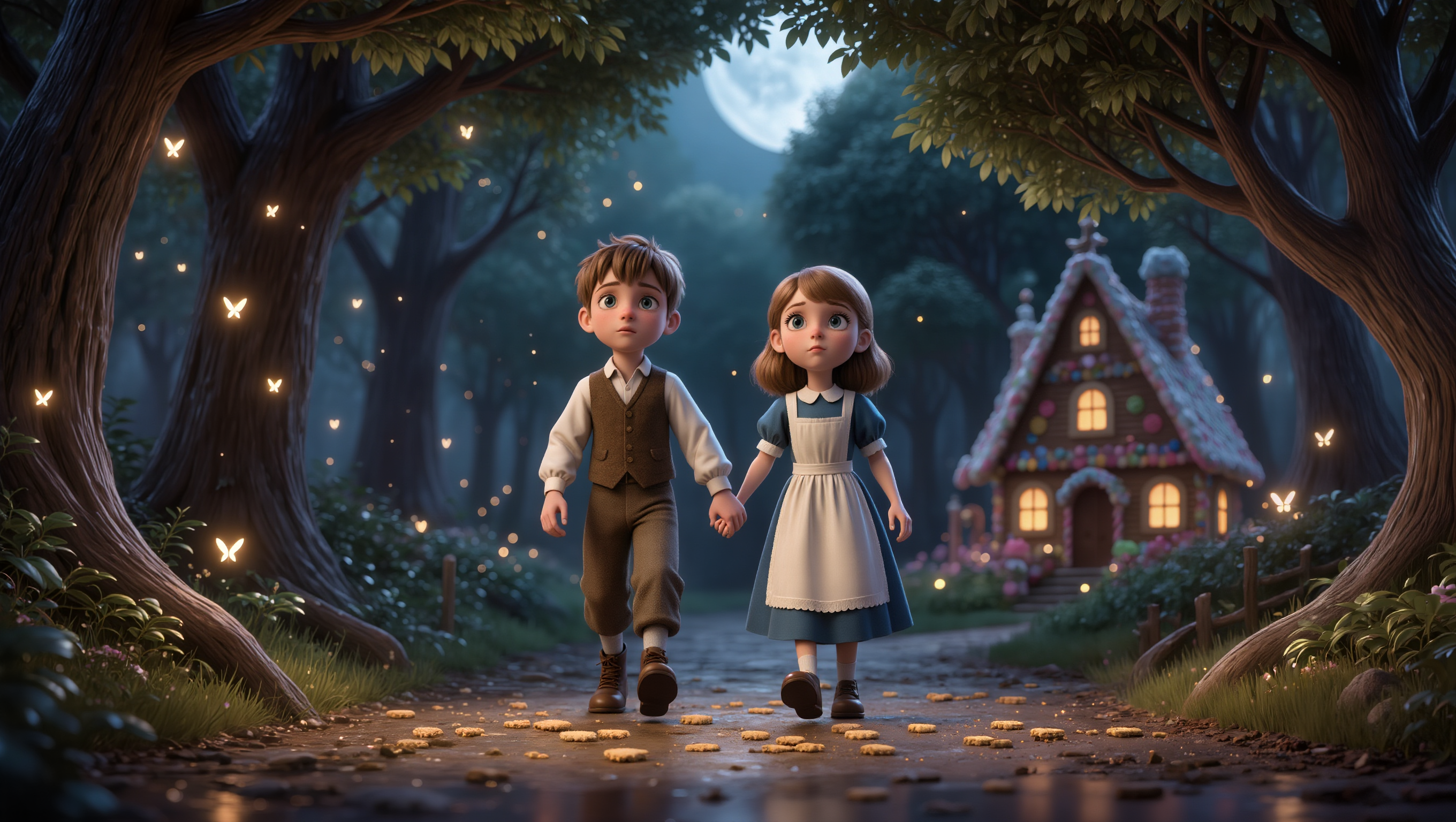
Long ago, in a cottage at the edge of a wide green forest, lived a woodcutter, his wife, and his two children, Hansel and Gretel.
Their home was small, but it always smelled of bread, pinewood, and the flowers Gretel tucked into jars on the windowsill.
Each night their father told them stories by firelight—tales about stars that guided lost travelers and animals that outsmarted hunters.
Hansel would listen with his eyes half-closed, already planning his own adventures. Gretel would lean against her father’s shoulder and whisper, “Tell that one again about the fox who found his way home.”
Then one year the rain forgot to fall.
The wheat turned pale, the river shrank, and the cupboards grew emptier each day.
Their father worked from dawn until the stars came out, but the forest could not fill the baskets as it once did.
One night, while the children pretended to sleep, they heard their father sigh.
“I can’t feed them,” he whispered. “What are we to do?”
His wife answered, “Tomorrow we’ll take them deeper into the woods. Perhaps they can gather berries—perhaps we’ll have enough for all of us.”
Hansel opened one eye and looked at his sister. “Don’t worry,” he whispered. “I’ll make sure we can find our way back.”
Before dawn, while the stars still shivered, Hansel slipped outside.
The moonlight painted the ground silver. He filled his pockets with small white pebbles that shone like tiny stars.
When morning came, the family set off together. The forest smelled of sap and dew, and sunlight dripped through the leaves like gold.
As they walked, Hansel quietly dropped one pebble after another along the path. Gretel saw and smiled faintly—she understood.
By noon, they reached the deepest part of the forest, where the trees stood close together as if whispering secrets.
“Stay here and pick berries,” said their stepmother. “Your father and I will fetch wood.”
But when the children looked up again, the forest had swallowed the sound of their footsteps.
Gretel’s voice trembled. “Hansel, what if they don’t come back?”
Hansel squeezed her hand. “They will. And if not, the moon will guide us.”
That night, the moon climbed high, and the pebbles gleamed like stars fallen to earth.
Hand in hand, they followed the shining trail all the way home.
Their father ran to meet them, his eyes wet. “My children!” he cried, hugging them tightly.
But the stepmother turned away, her mouth pressed thin as thread.
Days passed. The flour jar grew empty again. The stepmother scolded the air and muttered that two mouths were too many.
The next morning, she handed each child a crust of bread. “That must last you,” she said.
Hansel wanted more pebbles, but the door had been locked during the night.
So as they walked, he broke his bread into tiny crumbs and dropped them one by one onto the forest floor.
They walked for hours until even the birds grew quiet.
When the stepmother told them to rest and pick flowers, Hansel whispered, “Don’t worry, Gretel. I left crumbs to lead us home.”
But when the moon rose that night, every crumb was gone. The birds had eaten them all.
Gretel began to cry. “Now we’ll never find our way.”
Hansel bit his lip, thinking hard. “Then we’ll find something new,” he said. “We just have to keep walking.”
They wandered for days, living on berries and water from clear pools.
Sometimes they thought they heard footsteps behind them—but it was only the forest breathing.
Once, they found a hollow log and slept inside, watching fireflies drift past like lanterns.
Each morning, Hansel told Gretel stories to keep her brave. Each night, Gretel sang soft songs to keep him calm.
On the third day, they followed a bird with feathers bright as snow. It flitted from branch to branch, leading them deeper until—through a break in the trees—they saw something gleaming.
It stood in a clearing bathed in sunlight: a cottage made of sweet things.
The roof was chocolate brown, the walls were golden gingerbread, and the windows sparkled with panes of sugar glass.
Candy canes lined the path like soldiers, and the air smelled of cinnamon and honey.
Hansel’s eyes widened. “Do you think it’s real?”
Gretel touched the wall. It was warm, soft, and tasted like cake. “It’s real!” she said, laughing for the first time in days.
They broke off pieces and ate until their stomachs were full. “It’s like a dream,” Gretel murmured.
Just then, the door creaked open.
An old woman stepped out, her hair as white as flour, her shawl soft as smoke. “Well, well,” she said, smiling. “Two hungry children at my sweet little house! Come in, dears, come in. You must be tired.”
Inside, the cottage glowed. The table was set with milk, fruit, and warm bread.
Hansel and Gretel ate until they could eat no more. The woman tucked them into feather beds and hummed a tune that sounded almost like their father’s lullaby.
But when morning came, the air in the house felt heavy. The old woman’s smile had changed.
“Up, boy!” she said sharply to Hansel. “You’ll stay in this shed until you’re strong enough to help me with chores.”
Gretel stepped forward. “Please, may I stay with him?”
“You’ll work in the kitchen,” said the woman. “And do as you’re told.”
Each morning, Gretel brought Hansel food through the bars of the shed. “Don’t be afraid,” she whispered.
Hansel smiled bravely. “We’ll find a way out, like we always do.”
The woman checked Hansel’s hand each day to see if he was growing strong.
But Hansel was clever—he offered her a thin chicken bone instead.
“Still too skinny,” she muttered. “Eat more!”
Days passed like this. Gretel’s heart grew heavier, but she kept her mind sharp. She watched. She waited.
One morning, the woman ordered, “Light the oven. It must be hot enough for baking.”
Gretel’s stomach turned. She looked into the oven—it was wide and dark as a cave.
“Would you like to see if it’s ready?” she asked softly. “I don’t want to do it wrong.”
“Of course,” said the woman, bending closer. “Like this!”
Quick as lightning, Gretel gave a push, closed the heavy door, and ran to Hansel’s shed.
The key was hanging on a hook, just as she’d hoped.
The door swung open. “Hansel!” she cried.
He stumbled out, blinking at the sunlight. “You did it!”
They didn’t stop to look back. They ran until the trees opened above them like a sky.
By evening they found the river. Its water glimmered gold with the setting sun.
They followed it until they saw a path they remembered—the same path that led home.
Their father was outside chopping wood. When he saw them, the axe slipped from his hands.
“Hansel! Gretel!” he shouted, running toward them.
Gretel threw her arms around him. “We’re home!”
He held them close, his eyes wet. “I never stopped searching.”
Hansel opened the small pouch he carried. Inside were coins, pearls, and a tiny golden locket they had found in the sugar house. “We can buy flour and build a better roof,” he said proudly.
That night the cottage glowed again with the smell of bread and laughter.
The forest outside seemed softer now, almost kind.
Before bed, their father said, “You were clever and brave, my children. But more than that—you kept your hearts good.”
Hansel smiled sleepily. “And we know the forest better than anyone now.”
Gretel nodded. “The way home isn’t so scary once you’ve walked it.”
They fell asleep side by side, their father watching over them, the stars bright beyond the window.
And from that day on, whenever the wind moved through the trees, it sounded less like warning and more like welcome.
And they lived happily ever after.
Courage and cleverness can lead us home again.
Hansel and Gretel’s story teaches that bravery isn’t only about fighting — it’s about thinking clearly, staying kind, and helping each other even when life feels frightening. The children never stop believing they’ll find their way, and they use love and quick thinking to turn danger into safety. Their story reminds us that we can face hard things without losing hope, and that family, kindness, and courage can light the way through any dark forest.
Sign in to save words to your Word Garden - a special place to remember everything you’ve learned!
What makes Hansel and Gretel brave?
How did they use clever thinking to escape?
What do you think ‘home’ means in this story?