
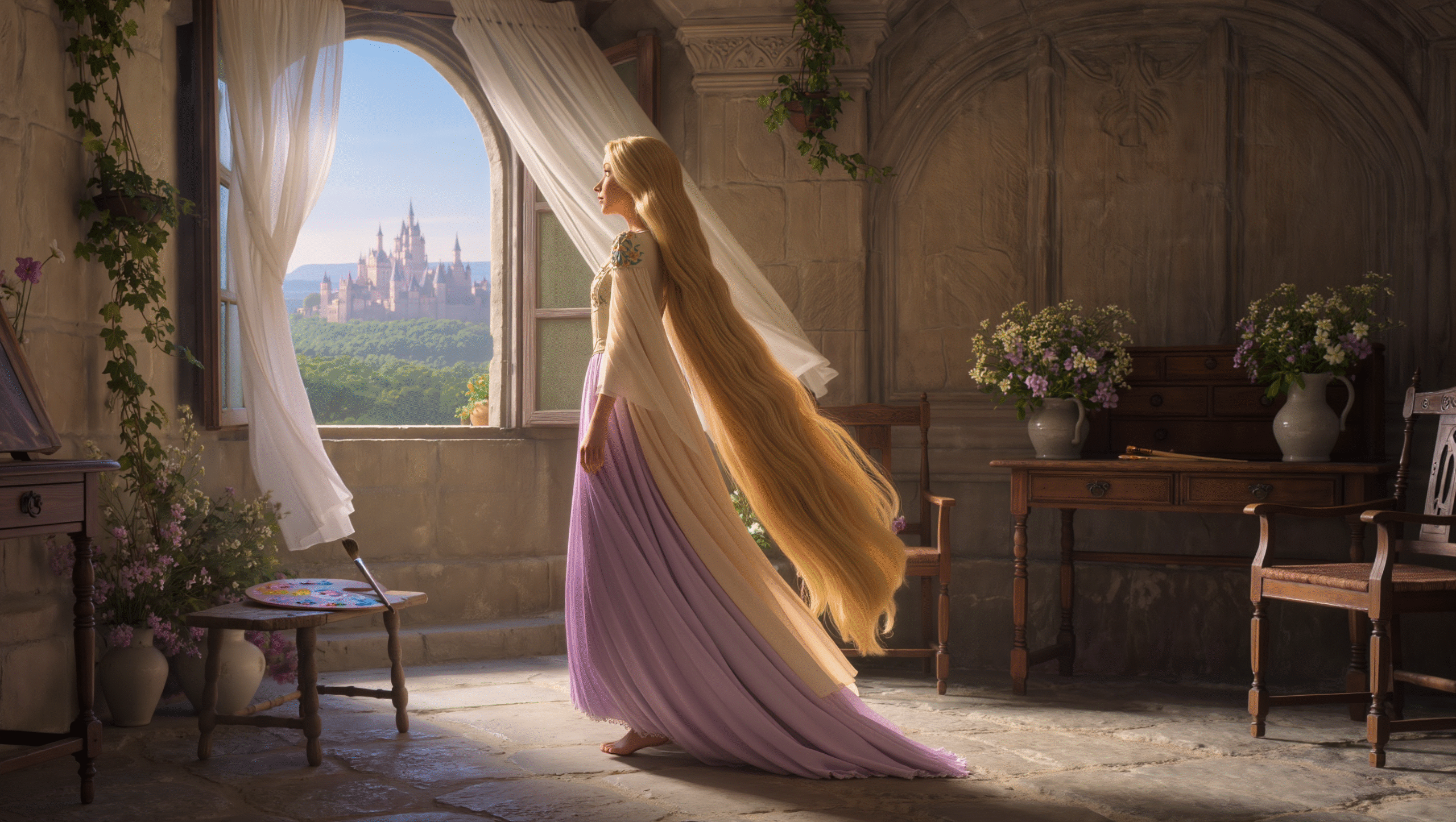
Once upon a time, in a quiet village surrounded by meadows and trees, there lived a kind man and a kind woman who longed for a child. Their house stood beside a tall stone wall. On the other side of that wall was a garden so green and perfect that it looked like something out of a dream.
The garden belonged to a woman called the Sorceress. She was not wicked, but she was secretive. People said she could speak to the wind and make flowers bloom before spring. In her garden grew herbs and roots for healing, and one patch of shining green rampion—a plant with curly leaves that smelled like mint and rain.
One afternoon, the woman looked out her window and saw the rampion sparkling in the sun. A wish rose in her heart so strong that it made her chest ache. “If only I could taste it,” she whispered.
The wish didn’t fade. Each day she grew quieter and paler. Her husband worried. “Tell me what’s wrong,” he said, and she told him about the rampion.
That night, when the moon was silver and thin, the man climbed the wall. He landed softly in the garden, picked a handful of rampion, and hurried home. His wife made a small salad and ate it slowly. “It tastes like the first rain,” she said, smiling for the first time in days.
But the next morning, the wish returned. She wanted more.
So, that night, her husband climbed the wall again. But this time, when he reached for the rampion, a quiet voice came from behind him.
“Why are you stealing from my garden?”
It was the Sorceress. Her eyes were sharp but not cruel. The man fell to his knees. “Forgive me,” he said. “My wife is going to have a baby. She wanted this so much I couldn’t say no.”
The Sorceress looked at him for a long moment. “You may take the rampion,” she said at last, “but in return, when your child is born, she will come with me. I will raise her safely. I will call her Rapunzel.”
The man felt as though the air had turned to stone, but fear made him agree.
When the baby was born—a small, golden-haired girl—the Sorceress came and lifted her gently into her arms. “Rapunzel,” she said softly, and the name seemed to glow in the room. The parents wept, but the Sorceress promised, “She will be loved and kept safe.”
Rapunzel grew quickly, full of light and laughter. She sang when she brushed her hair, when she swept the floor, when she fed the birds outside the window. Her voice was soft but strong, and it made even the Sorceress pause to listen.
The Sorceress loved Rapunzel, but she also feared the world. “The world can be harsh,” she said. “I must keep you safe.”
So when Rapunzel turned twelve, the Sorceress took her deep into the forest to a tall white tower. It had no door and no stairs, only one round window high above the trees.
“This will be your home,” the Sorceress said. “You will have books, bread, and paints. You will have the sun and the stars. You will be safe.”
Rapunzel tried to be brave. The room was bright and cozy, but the walls were high and silent. She grew herbs in pots on the windowsill and sang to them as she watered. She painted the clouds that drifted past and talked to the birds that perched on her ledge.
Each day the Sorceress came to visit. She stood below the window and called,
“Rapunzel, Rapunzel, let down your hair!”
Rapunzel wound her long golden braid around a hook and lowered it out the window. The Sorceress climbed up, hand over hand, until she reached the room. Together they baked small cakes, told stories, and watched the clouds change color at sunset.
One afternoon, while Rapunzel was singing to the forest, a young prince rode by. He was kind and curious, with eyes that saw beauty in small things—a puddle’s reflection, a patch of moss, the sound of wind through leaves.
When he heard Rapunzel’s voice, he stopped and listened. The song drifted through the trees like golden thread. He searched for its source and found the tall tower. He rode around it twice, looking for a door, but there was none. He looked for steps, but there were none.
The song ended, and he rode away, thinking of the voice that made his heart feel lighter.
The next day, he returned. At sunset, he hid among the trees and waited. Soon a woman in a dark cloak stepped into the clearing. She looked up and called,
“Rapunzel, Rapunzel, let down your hair!”
A golden braid fell from the window, shining in the fading light. The prince watched, amazed, as the woman climbed the wall and disappeared through the window.
He came back again the next evening. The forest was quiet. The prince stood where the woman had stood and called softly,
“Rapunzel, Rapunzel, let down your hair!”
Rapunzel, thinking the Sorceress had come early, let her braid fall. The prince climbed carefully, calling up gentle words so she wouldn’t be afraid. “Please don’t worry,” he said. “I heard you sing, and I had to meet you.”
When he reached the window, he bowed—not like a prince to a subject, but like one person greeting another.
Rapunzel stepped back, surprised. “You’re not the Sorceress,” she said.
“No,” he smiled. “But I mean no harm. I only wanted to hear your song again.”
Rapunzel saw the kindness in his eyes and felt something new: trust. She nodded slowly. “Then you may stay awhile.”
They talked until the sun melted behind the trees. The prince told her about the city, the river that ran through it, and the market that smelled of bread and apples. Rapunzel listened as if she were drinking sunlight.
The prince returned many times. He brought her small gifts—a blue ribbon, a red apple, a book of poems. Rapunzel showed him her paintings and sang songs she had written. The tower didn’t feel so small anymore.
But the Sorceress noticed the change. One morning, when she climbed the braid, she looked at Rapunzel carefully. Her cheeks were pink; her eyes sparkled. “You seem different,” she said. “Has someone been here?”
Rapunzel had never learned to lie. “A prince visits me,” she said softly. “He tells me about the world. I sing for him.”
The Sorceress’s heart filled with fear. She loved Rapunzel deeply, but her love had no room for trust. In her panic, she made a terrible choice.
That night, she cut Rapunzel’s long braid with one sharp snip. “You must be hidden where no one can find you,” she said. She carried Rapunzel far away to a quiet valley with a little house and a well. “You will be safe here,” she whispered.
Rapunzel wept for her lost tower and her friend who would not find her, but she learned to live gently in the new place. She planted beans by the window, baked bread, and sang to the sky. Her hair grew again—not as long, but soft and bright.
The next evening, the prince came to the tower and called, “Rapunzel, Rapunzel, let down your hair!”
The braid fell, and he climbed quickly. But when he reached the window, the Sorceress was waiting. “Rapunzel is gone!” she said, and her anger was so fierce that the prince stepped back, lost his grip, and fell into the brambles below.
The thorns scratched his face and stung his eyes until he could barely see. He wandered then, following the sound of streams and the feel of wind. He shared bread with strangers and carried Rapunzel’s song inside him like a small light that refused to go out.
In her quiet valley, Rapunzel woke each morning to the sound of birds. She grew herbs and traded bread for milk and honey. Her heart still ached, but she stayed kind.
One spring morning, while she was singing the song the prince had taught her—about rivers, bridges, and laughter—she heard a careful step on the path.
“Is someone singing?” a familiar voice asked.
Rapunzel ran to the door. The prince stood there, taller and thinner, his eyes clouded from the thorns. He turned toward her voice, hope trembling in his face. “Rapunzel?”
“Yes!” she cried. She took his hands and wept. Her tears fell on his cheeks, warm and bright, and slowly, his sight cleared. He blinked and saw her smiling—her short hair shining in the sunlight. He laughed and cried at the same time.
They told each other their stories—of wandering, waiting, and learning to hope again. Then the prince said, “Come with me. Come home.”
Rapunzel looked at the bean plants curling up the sticks by her door. She smiled. “Yes,” she said. “Let’s go.”
They rode together to the prince’s kingdom. The king and queen welcomed Rapunzel with joy. The people cheered when she sang from the balcony, her voice floating through the streets like a ribbon of gold.
Far away, the Sorceress tended her garden and listened to the wind. For the first time in years, she didn’t feel afraid. “Be happy, my child,” she whispered. “You are safe and free.”
And from that day on, Rapunzel lived in a home with wide windows and no locks. Every morning, she opened them to let the world in. Her songs drifted through the air, bright and kind, and wherever they went, people smiled.
And they lived happily ever after.
Real love means trust, not control.
Sign in to save words to your Word Garden - a special place to remember everything you’ve learned!
Why did the Sorceress lock Rapunzel in the tower?
What helped Rapunzel stay hopeful while she was alone?
What kind of bravery did Rapunzel and the Prince show?