
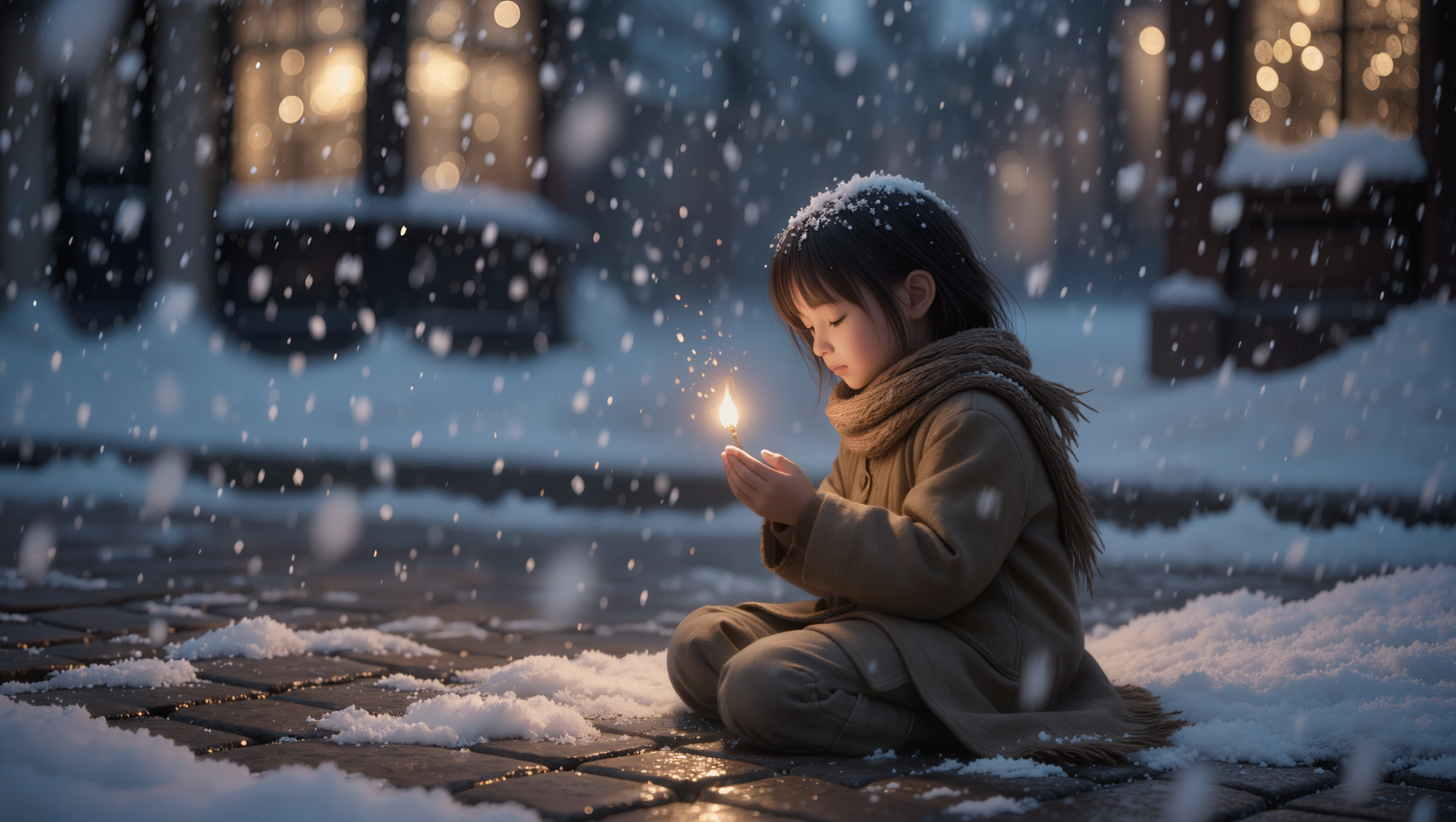
Snow was falling thick and soft, turning the city into a world of white. Rooftops wore sleeping caps. Chimneys breathed pale smoke. Streetlamps shone like small moons, their light pooling golden on the cobblestones before the wind swept it thin again. Doors opened and shut along the long street, spilling warmth for a heartbeat, then closing it away.
Along that street walked a small girl named Lila. Her coat was too thin for a night like this, and her shoes were much too big. The toes were split, and when she stepped into a drift, snow slipped in and kissed her feet. She held a bundle of matches tied with a piece of string as carefully as if it were a treasure.
“Matches,” she called, gentle and shy. “Matches for sale.”
No one stopped. A man hurried past with his collar turned up. A woman carried a basket with oranges wrapped in tissue paper. Children ran, laughing, their boots throwing up little storms of powder. Lila watched the doors swallow them, one by one, and tried to picture the rooms beyond—firelight, a kettle singing, mittens steaming on the hearth.
She paused at the bakery window. Heat fogged the glass. Inside, the baker dusted flour from his apron and lifted a tray of rolls that shone with butter. His helper shook out a cloth, and for a moment flour drifted down like a private snowfall. Lila pressed her fingers to the pane. The glass was cold, but the sight was warm, and she drew a tiny heart in the fog before the wind wiped it away.
“How nice it must be,” she whispered, “to be warm and full.”
Her breath made small clouds. Snow hid the seams of the street, making everything soft at the edges. Lila pulled her coat tighter, lifted her bundle of matches as if it might lift her too, and walked on.
She thought of her grandmother. The shoes had once been hers, the good stories too. In those stories, small lights found their way through big darks, and angels walked like ordinary people until you looked twice. Her grandmother used to stroke Lila’s hair and say, “Even the smallest flame knows the way home.” Lila had believed it then. She believed it now, though the night pressed close and the wind tried to make her doubt.
“Matches,” she called again. “Matches for sale.”
A boy with a sled slowed and peeked. He held a coin, then looked toward his house where someone was calling him in. He squinted at Lila’s bundle, at her red hands, at the shadows under her eyes. “Maybe later,” he said, and ran.
Lila smiled anyway. She liked to. Smiling made the cold feel a little less sharp.
The street grew quiet. The last shopkeeper locked his door and hummed as he walked away. Somewhere far off, bells began to ring. Lila turned down a narrow lane between two tall houses where the wind could not find her so easily. There was a dry stone step by the wall. She sat, tucked her feet under her skirt, and listened to the soft hiss of falling snow.
The matches clicked together in her hands. She liked their neatness. She liked the way the thin sticks felt like promises—fragile, yes, but ready.
Her fingers ached with cold. “If I light just one,” she said to herself, “it might make my hands warm for a moment.”
She slid a match from the bundle and struck it against the wall.
Fssst.
A spark woke, small and brave. A golden flame bloomed at the tip, and the darkness stepped back in a tidy circle. In that circle Lila saw a great iron stove. It stood just as it had in her grandmother’s kitchen—black sides, red coals, little window of light. Heat reached toward her as if it had been waiting. She held out her hands and felt the stiff ache soften, the sting ease, the cold forget her for a breath.
“Oh,” she said, smiling because she could not help it. “That’s lovely.”
The match burned down. The circle closed. The stove folded into shadow. The cold slid back over her fingers, curious and sure.
“It was beautiful,” she told the air, and meant it.
She drew out a second match and struck it.
Fssst.
This flame leapt higher, eager and bright. In its light a long table appeared, covered with a white cloth that fell in clean folds. There was soup that steamed like small clouds. There were loaves that sighed when torn, butter sliding to shine their edges. There was a roast goose with skin the colour of treasure, and pears glowed like lamps in a bowl of leaves. Lila breathed in, almost tasting cinnamon and pepper and the good, honest salt of broth.
She laughed—quietly, surprised—and lifted a hand to reach. The match went out. The table ebbed back into the night as if it had been tide and she had been shore.
“Even seeing it was kind,” she said. She rested a moment, listening to the snow.
She slid out a third match.
Fssst.
This light was softer, like candle flame behind a curtain. And in that light stood her grandmother. Not thin as smoke and not far as a dream—right there, with the same eyes that always found the good, the same mouth that could make lullabies out of ordinary words.
“Grandmother,” Lila breathed, and her voice was a laugh, a sob, and a relief.
“My little one,” her grandmother said, and her voice did what it always had—it rounded the world’s sharpness, it made space for breath. “You have been very brave.”
“Please don’t go,” Lila said quickly, for the match was already shorter. “Please—take me with you. It’s so cold.”
The flame trembled. Her grandmother’s face thinned. Fear fluttered in Lila’s chest like a bird behind a shutter, and her fingers, faster than thought, found another match.
Fssst.
Light sprang up. Her grandmother brightened, as if she were made of the same gold. “Whenever you see a light,” she said, “that is my love, finding you.”
Lila struck another, then another. Flames flowered around her, each a small sun, until the narrow lane wore a little sunrise of its own. Snow at her feet turned silver. The wall near her shoulder glowed. The cold took a careful step back, as if it had remembered its manners.
“Come,” said her grandmother, holding out her hand.
Lila stood. Her numb feet still touched stone, yet the stone did not feel cruel. Her fingers slipped into the warm hand she loved, and together they began to walk. They moved through the lane, and the lane changed. Houses softened at the edges. The lamps became stars hung lower than usual, curious and kind. The air smelled faintly of oranges, pine, and something sweet she could not name, only trust.
“Where are we going?” Lila asked.
“Home,” her grandmother said.
“Will there be a stove?” Lila asked, smiling because the thought was simple and perfect.
“There will be warmth,” her grandmother said.
“And a table?” Lila asked, thinking of soup and pears and bread that sighed.
“There will be enough,” her grandmother said.
“And you?” Lila asked, and the question made her ashamed of how much she wanted.
“I will be where you are,” her grandmother said.
They walked past a window where a family sang while they trimmed a tree. They walked past a door where someone had left a candle for a late-coming friend. They walked by the bakery, where the last heat made the air sweet. No one inside saw the two figures in their small, steady daybreak. The world went on being itself, and Lila and her grandmother went on being a quiet brightness inside it.
The matches burned low; Lila struck more. She had never known she could hold so much light in two small hands. She had never known a few thin sticks could become a road.
They reached the end of the lane, where the snow fell as if the sky had been saving some just for this corner. Lila tipped her face up. The flakes did not sting; they felt like soft hands patting her cheeks. She laughed, and the laugh rose in the light like a new match.
“Grandmother,” she said, “I’m not cold.”
“I know,” said her grandmother, and her voice was a blanket. “You are safe.”
“Will I remember the stove?” Lila asked.
“You will remember the warmth,” said her grandmother.
“And the table?”
“You will remember the enough.”
“And you?”
“I am the remembering,” her grandmother said.
They stepped forward, and the street unspooled into a bright mist. A smallest star, the one that had seemed to follow, hung closer, as if it wanted to hear the rest.
Far away, the church bells began again. The sound climbed the air like ladders, and Lila climbed too, without lifting her feet. She felt lighter, as if a heavy coat had been taken off her shoulders, as if a name she had been carrying was at last being said kindly.
“Home,” her grandmother said again, and Lila believed her completely.
Morning came like a slow breath. The city opened its eyes. Snow lay deep on the rooftops and tucked itself into gutters. People pushed open shutters and blew white puffs into the bright air. A dog shook snow from its back and sneezed.
The baker turned into the narrow lane with a basket of bread. He stopped. On the stone step against the wall sat a small girl, her head at a tender tilt, a faint smile living at the corner of her mouth. Beside her lay a bundle of matches tied with string; several small sticks were burned all the way to their ends.
“Oh,” the baker said, and his breath made a shape in the winter light. “Poor child.”
He took off his scarf and tucked it around her, though he knew scarves are for warmth and the work of warmth seemed finished here. A woman with a broom came and stood; a man with a pail set it down; the boy with the sled did not yank his rope or speak. They all saw the same thing: a face at peace, as if listening to a soft song too gentle for the busy day.
They shook their heads. One pressed a hand to her heart. One blinked away tears that the cold turned sharp and bright. They looked at the little burned ends of the matches and said, as people always say when they are late to kindness, “She must have tried to keep warm.”
None of them saw the last thin ribbon of brightness lifting like breath. None of them noticed how the air above the step held a small glow, as if the morning had left a candle there for itself.
The baker waited a little longer. Between the tall houses, the clouds parted in a private way, letting a small blue through. A beam of sun slid in and made a neat, warm stripe exactly where the girl sat.
“It feels warmer,” the baker said to no one, and carried his bread into the day.
Winter folded into the rest of the year and back again, as years do. The city went on being a city—loud when the market was loud, quiet when the bells were quiet, ordinary as bread and strange as snow at midnight. But people remembered the little girl with the matches. They said her name—Lila—and it sounded like a match being struck.
They told her story at stoves and tables. Mothers said, “When you see the first star, think of her.” Fathers pointed: “The smallest, steadiest one.” Grandmothers stirred soup and whispered, “Even the smallest flame knows the way home,” and sometimes a child felt a hand smooth hair that no one could see.
Sometimes, on nights when the lamps trembled a little in the wind and the snow fell as if it meant to fall all night, someone walking through the narrow lane would pause without knowing why. The air there would feel warmer than it had any right to be. Bread would taste a little better if you ate it on that step. Dogs liked to stop there and wag once, grave and friendly. Children tugged sleeves and said, “This is the warm corner,” and the grown-ups, who had once been children, nodded.
People began to leave small candles in windows on the coldest evenings. Not many—just enough to look like stars had come inside to rest. A circle of light on glass made a passerby brave. A flame on a counter softened a voice. A tea shop set a candle by the cakes, and laughter learned the way back. It wasn’t exactly magic, or else it was the oldest kind—the kind that happens when people try to take care.
If you walked through the city late, you might see a glow where no lamp hung. It would hover for a blink, a gold moth of light that did not mind the wind. You might feel something settle at the center of you, like a cup being set on its saucer, like a hand finding yours in the dark.
And if a child asked what the story meant, someone would fold them into a coat and say, “It means that light belongs to everyone. It means that love learns your name by heart. It means that even on the coldest night, there is a way home.”
The snow would keep falling when it wished. The bells would keep ringing when they were told. Doors would go on opening and shutting, and warmth would go on spilling and being saved. But somewhere—on steps, in windows, along the edges where wind forgets to blow—there would always be a little extra brightness, just enough for those who are the noticing kind.
As for the matches, people kept them in drawers and pockets, the way people do. Struck carefully, they flowered into that same sure gold—small, steady, certain of their job. And every time a light bloomed in a dark room, someone somewhere remembered a girl with shoes too big, a bundle tied with string, and a path that rose from a handful of flames.
If you ever walk down that lane and feel, for no reason, that the world has leaned closer to be kind to you, perhaps you are near the place where Lila learned to carry brightness. Perhaps you have stepped, for the length of a breath, into her circle. Perhaps the smallest star is following you home.
And if you find yourself cold or afraid, whisper what she was told and then discovered to be true: even the smallest light knows the way through the dark.
Even the smallest act of hope can shine in the darkest moments.
Lila’s story shows that kindness, courage, and imagination can bring light to even the coldest night. Her matches didn’t just give heat — they carried love, memory, and faith that warmth still exists in the world. We learn that light isn’t only fire or sun; it’s what we give to others when we care, when we notice, when we remember someone who might be alone.
Sign in to save words to your Word Garden - a special place to remember everything you’ve learned!
What do Lila’s matches really mean?
Why didn’t anyone stop for Lila?
How does the story feel at the end — sad or peaceful?